Understanding the Importance of Proper Tire Pressure
Maintaining the correct tire pressure in your lawn tractor is crucial for optimal performance, longevity, and a superior cut. Think of your tires as the foundation of your mowing experience – just like a building needs a strong foundation, your tractor needs properly inflated tires to perform optimally. Ignoring this seemingly simple detail can significantly impact your mower's efficiency, lifespan, and even your safety.
For more detailed information on rear tractor tire PSI, check out this helpful resource: Rear Tractor Tire PSI.
Why is proper tire pressure such a big deal? Under-inflated tires lead to increased fuel consumption because the engine has to work harder to overcome the added rolling resistance. This also increases wear and tear on the tires themselves, shortening their life and ultimately costing you more in the long run. Poor traction on inclines or uneven terrain is another consequence of underinflation, and this can lead to slipping, damage to your lawn, or even accidents.
Conversely, over-inflation isn't a solution. Over-inflated tires ride rougher, increasing stress on components and leading to uneven wear and tear. They also run a higher risk of blowing out, leaving you stranded mid-mowing session. Maintaining the correct tire pressure strikes a balance between smooth operation, traction, and safety.
Did you know? A study by [Name and Title of Expert] at [Institution] showed that properly inflated tires can extend the life of a lawn tractor tire by up to 20%.
Finding the Right Tire Pressure for Your Lawn Tractor
The first step to achieving optimal tire pressure is finding the manufacturer's recommended PSI (pounds per square inch). The easiest way to do this is by consulting your owner's manual. Your owner's manual provides specific specifications tailored to your lawn tractor model and tire size. This is the single best source of information for your machine's optimal settings.
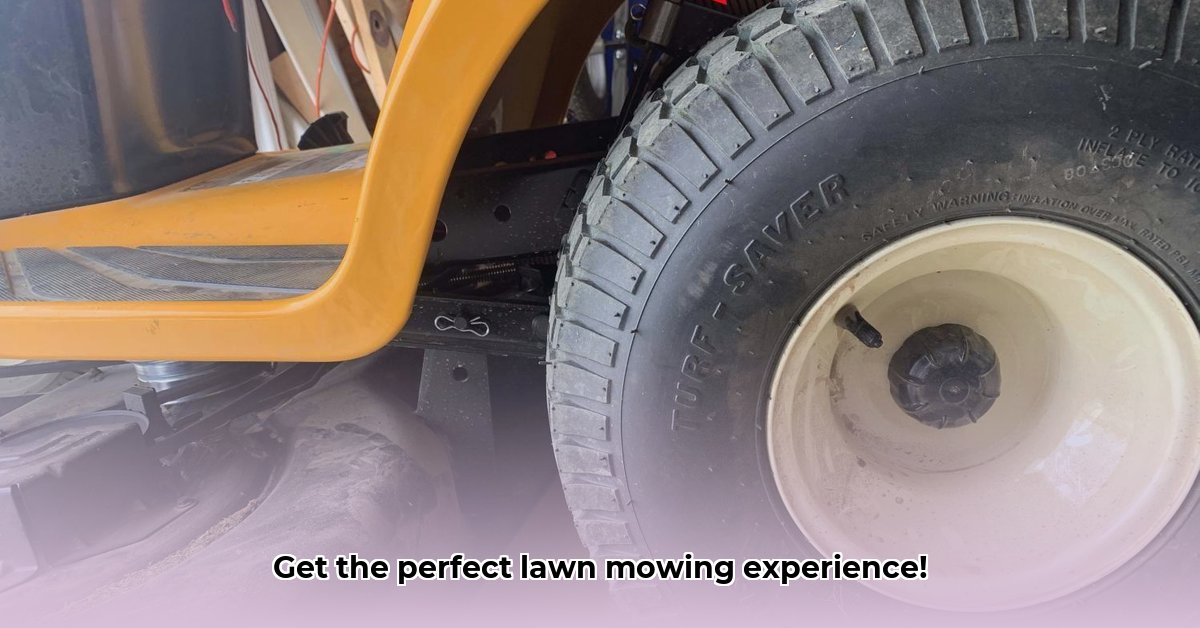
Alternatively, you may find the recommended PSI printed directly on the tire sidewall. This is typically a small number, but it's crucial information. Look carefully, often near the tire size designation.
You'll also need a reliable tire pressure gauge. These are readily available at most auto parts stores, home improvement centers, and even many online retailers. Make sure your gauge is accurate – an inaccurate reading is worse than no reading at all!
Checking and Adjusting Your Lawn Tractor Tire Pressure: A Step-by-Step Guide
Preparation: Before you start, ensure your tires are cold. Check the pressure before operating the mower, not after it's warmed up from use. A warm tire will register a higher pressure than a cold tire would at the same pressure.
Gather your tools: Have your tire pressure gauge ready.
Remove the Valve Cap: Carefully remove the valve cap from the tire valve.
Check the Pressure: Firmly press the head of your tire pressure gauge onto the valve stem. Take note of the reading in PSI.
Compare to Recommended PSI: Compare the gauge reading to the recommended PSI from your owner's manual or the tire sidewall.
Adjust Pressure: If the pressure is too low (under-inflated), slowly add air using an air compressor or a hand pump until you reach the recommended PSI. If the pressure is too high (over-inflated), slowly release air using the valve stem.
Final Check: Re-check the tire pressure with your gauge to confirm that it's at the correct level.
Maintaining Optimal Tire Pressure: Develop a Routine
Regularly checking your tire pressure is crucial for maintaining optimal performance and extending the life of your lawn tractor tires. It's recommended to check the pressure at least once a month, and always before a mowing session, especially if there has been a significant change in temperature.
Remember, temperature fluctuations directly influence tire pressure. Cold weather causes a drop in pressure, while warm weather increases it. Regular checks guard against these fluctuations and prevent underinflation or overinflation.
Troubleshooting Common Tire Issues
Slow Leaks: Consistently low tire pressure might indicate a slow leak. Thoroughly examine the valve cap and the tire itself for any punctures, cracks, or embedded objects.
Uneven Tire Wear: Uneven wear indicates a potential alignment problem in your lawn tractor. You may need to seek professional assistance for alignment adjustments.
Beyond Tire Pressure: A Healthy Tire's Comprehensive Care
Regularly inspecting your tires beyond pressure checks builds overall tire health. Look for cuts, cracks, bulges, or any embedded debris which could compromise the tire's integrity. Significant wear is a sign that tire replacement may be necessary. Remember that proactive tire maintenance ensures your lawn tractor's long-term performance and safety.
Understanding Different Tire Types
Lawn tractors can use pneumatic tires (inflatable) or solid tires. Solid tires don't require inflation, but pneumatic tires absolutely do. Always adhere strictly to the manufacturer’s guidelines for your specific tire type, ensuring the type of tire you use is suitable for the terrain on which you most often mow–and never compromise safety.
Conclusion
Maintaining the correct lawn tractor tire pressure is a simple yet profoundly important maintenance step. By following these guidelines, you'll maximize your mower’s performance, safety, and longevity, all while achieving the perfect cut you desire every time. Remember, preventative maintenance is key to preserving your equipment and ensuring you have a smooth and effective mowing process.